

atNorth
From Ambition to Action: Shaping Sustainability in the Data Center Industry
Ecobio supports Nordic data centre operator atNorth with a comprehensive package of services for sustainability and EU Taxonomy alignment. Over the years, the partnership has included, among other things, work on certified management systems, value chain mapping, compliance work, climate risk assessments and transition planning. The scope has expanded as atNorth’s needs have evolved.
atNorth develops and operates data centres in Iceland, Sweden, Denmark, Finland and Norway. Data centre businesses face growing expectations and scrutiny worldwide regarding resource use, particularly energy consumption, as well as climate resilience and environmental performance. They are also expected to engage meaningfully with local communities to understand their priorities, needs, and aspirations as well as address any concerns and create lasting value in the area.
atNorth is working to raise the bar for sustainability in the industry and lead by example, incorporating regeneration and regenerative principles into its work. Ongoing engagement with local communities is guided by a listening-first approach.
“We at Ecobio are all in supporting atNorth with this ambition. Our discussions around the different aspects of sustainability, as well as the related solutions, challenges and opportunities, have been extremely interesting also for us. It is rewarding to have the opportunity to support the client in creating ambitious plans and turning them into practice”, Sanni Aumala, Senior consultant at Ecobio, says.
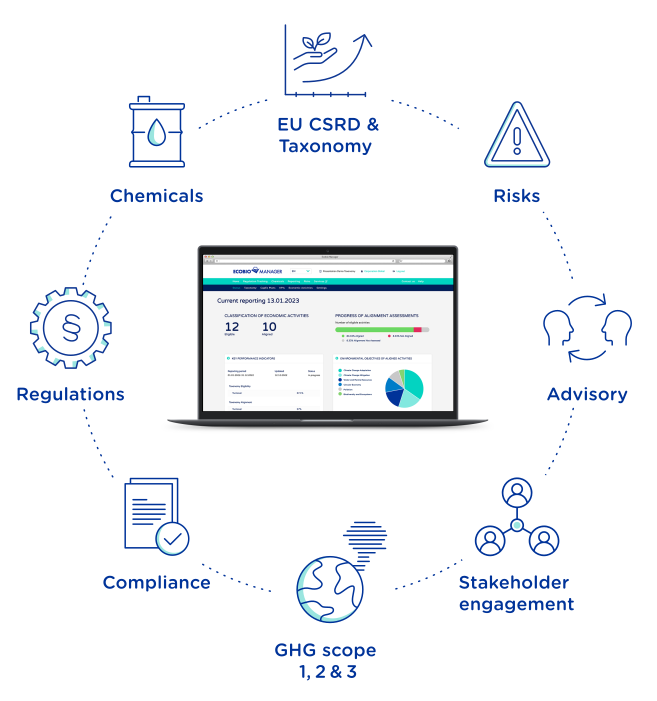
Originally, the collaboration between atNorth and Ecobio began with support for ISO management systems and certification. atNorth also uses Ecobio’s own sustainability and compliance software, Ecobio Manager, for regulatory monitoring and chemical management. This existing base of working together provided a good starting point when the collaboration expanded into more complex taxonomy and climate-related projects.
EU Taxonomy compliance for a data centre company
Data centres combine continuous service requirements with high energy demand, cooling needs and investments in buildings and technical infrastructure. New facilities must be designed for a long operating life, while capacity and technology develop rapidly.
The EU Taxonomy sets criteria for environmentally sustainable activities. Depending on the company, demonstrating alignment may require climate risk assessments, adaptation measures, environmental safeguards and supporting documentation.
For a data centre operator, this involves, for example, assessing location-specific climate and water risks, reviewing cooling and power-system solutions and, where relevant, examining the lifecycle impacts of construction projects.
Each assessment contributes to the same objective: building a clearer understanding of the company’s operations and sustainability performance through a single, unified process.
“The collaboration gradually expanded as atNorth identified the different elements required for their taxonomy and sustainability and regeneration work”, Aumala explains.
Value chain mapping & data centre climate risk assessment
Ecobio helped atNorth define and document its value chain, providing a basis for identifying sustainability impacts, risks and opportunities. Following the value chain mapping, Ecobio supported atNorth in conducting a climate risk assessment informed by the requirements of the Corporate Sustainability Reporting Directive (CSRD). The assessment considered physical and transition climate risks relevant to atNorth’s data centre operations and was later on extended to address the climate risk and adaptation requirements of the EU Taxonomy.
“For a data centre operator, both physical climate risks and transition risks are central to understanding future operating conditions. Data centres, for example, require significant amounts of energy for cooling. As temperatures rise and heatwaves become more frequent and intense, it is important to assess the vulnerability of facilities and determine how cooling systems and other critical infrastructure can be adapted to changing climatic conditions.” explains Minja Sillanpää, climate consultant from Ecobio.
From a transition-risk perspective, regulatory requirements, technological developments and reputational expectations are also increasingly important.
“As significant consumers of energy and, in some cases, water, data centres need to consider how to improve energy efficiency, enable waste heat recovery and reuse, minimise water consumption and transition away from high-GWP refrigerants. These considerations help ensure that data centre operations remain compatible with the broader transition towards a low-carbon and resource-efficient economy”, Sillanpää continues.
The assessment covered physical climate risks under two scenarios: a high-emissions scenario and a controlled-emissions scenario. Transition risks and opportunities were assessed using a Paris Agreement-aligned scenario. The project involved stakeholders from atNorth’s local sites around the Nordics
“The climate risk assessment brought together colleagues from our sites and central functions across the Nordic region. Their operational knowledge was essential to understanding how physical and transition climate risks could affect individual locations and to identifying practical adaptation priorities. The process gave us a stronger, more consistent basis for integrating climate resilience into site-level planning and decision-making”, Justice Selorm Nutakor, Sustainability and Regeneration Manager from atNorth sums up.
Climate transition planning and the Net Zero Data Centre Plan
The collaboration has further expanded to support the development of atNorth’s climate transition plan. The work focuses on defining credible pathways for reducing Scope 1, 2 and Scope 3 emissions towards 2030, including site-specific actions, operational dependencies and the technologies required to support implementation. One of the main goals is to plan and map site-specific emission reductions and the technologies required to achieve them.
“Our site-level workshops have helped us identify the main emissions sources, understand local challenges and dependencies, and define the measures required at each location. This gives us a more practical and credible pathway for translating company-level climate targets into site-level implementation” explains Justice Selorm Nutakor, Sustainability & Regeneration Manager at atNorth.
A related workstream, the Net Zero Data Centre Project, explores how lifecycle emissions from both data centre construction and operation could be minimised. Its purpose is to develop a practical blueprint, assess how close to zero emissions a data centre can realistically reach, and identify where further technological and market development is required. The work is intended to provide a practical basis for reducing lifecycle emissions in future data centre development and operation, while identifying the technical and commercial challenges that still need to be addressed
The project grows as the focus becomes clearer
Sustainability work often begins with a broad requirement that must be translated into a company-specific context. At the start of a project, relevant questions or useful workstreams may still be unclear. A flexible way of working has been central to the collaboration with atNorth.
“We worked with atNorth on a weekly basis for approximately a year, building each project on the previous work. With broad projects such as a transition plan, the full scope can be difficult to define all at once. We created the first version and then developed it further based on where it could provide the greatest value. This allowed the project to grow and adapt as the focus became clearer”, Sillanpää explains.
The adaptable way of working also keeps the projects connected with changing business needs. This is especially important in a sector such as data centres, where both regulatory requirements and evolving technologies can alter the available options throughout a project. The scope can be adjusted to ensure that the outcome remains relevant to the current situation.
“The aim is to produce something that genuinely supports real decisions and implementation”, Sillanpää says.
atNorth appreciated Ecobio’s flexible approach as the project evolved. The project workshops created an environment for more in-depth discussions among professionals and teams from different sites and fields within the company.
“The combination of an in-person kick-off and focused online workshops has worked well. It enabled Ecobio to engage directly with our key stakeholders while giving us a practical and flexible way to continue developing the work across our Nordic operation”, Nutakor sums up.
ECOBIO MANAGER
The most comprehensive software suite on the market,
developed by sustainability experts.
- CSRD, VSME and EU Taxonomy reporting
- Chemical management
- Legal requirements and regulatory monitoring
- Compliance assessment
- Risk management
- Carbon footprint calculator
- Climate scenarios and risks
“Ecobio engaged directly with our key stakeholders while giving us a practical and flexible way to continue developing our operations”
Justice Selorm Nutakor
Sustainability and Recreation manager
Contact us

Sanni Aumala
We help you balance business and nature